"Rep. Khanna's State Based Universal Healthcare Act of 2019 is an important possession to the motion for a universal national health insurance and Medicare for All. There is strong motion in a variety of states to accomplish universal and budget friendly healthcare at the state level. As we work towards Medicare for All, the SBUHC Act will enable some states to transition to universal, single-payer systems that can function as models for national Medicare for All.

" States that wish to guarantee healthcare to all their citizens through a universal health care system face effective political resistance from the insurance market. They shouldn't need to face added obstacles from our federal government. The State-Based Universal Health Care Act would make sure that states have complete versatility to react to public needs and satisfy the health care needs of their individuals," stated Ben Palmquist, Health Care Program Director at the National Economic & Social Rights Effort.
Only by risking violating those laws can states dare to develop their own health care systems for their own residents designed by their own legislatures. The State Based Universal Health Care Act of 2019 supplies that freedom. If passed, this allows far-sighted states to offer much better care to more individuals for less cash, a responsibility Congress declined to assume despite decades of fatal ineffectiveness in America's healthcare system.
" We all know that our healthcare system is broken. The health care our families should have can just be attained through a coordinated single payer system. Everybody in and nobody neglected. The affiliates of the Center for Popular Democracy are committed to winning that system nevertheless we can. Numerous have actually been fighting, and winning, at the State level to advance universal healthcare in the States and Regions and Rep.
We are delighted to use our assistance," stated Jennifer Epps-Addison, CPD/A Network President and Co-Executive Director. "Whole Washington, a grassroots organization dedicated to getting single payer health care passed both nationally and in Washington State, happily endorses Representative Khanna's State Based Universal Health Care Act of 2019. Canada passed their single payer system province by province beginning with Saskatchewan, and Whole Washington aims to follow a comparable design.
Due to the current federal laws, it's difficult for states to develop a true Drug Rehab Delray single payer system without waivers. Rep. Khanna's bill would streamline this process, making it much easier for states like Washington to pass legislation that http://daltonrfef046.lowescouponn.com/how-to-get-health-care-questions would cover the millions of uninsured and underinsured citizens in our state, while leading Find out more the charge for a federal improvement," stated Jen Nye, Communications Director, Whole Washington.
Khanna is likewise the sponsor of the Prescription Drug Rate Relief Act, a costs introduced with Senator Sanders, to substantially decrease prescription drug rates for Americans. Check Out the State-Based Universal Health Care Act online here. Rep. Jayapal (WA-07), Rep. Blumenauer (OR-03), Rep. Bonamici (OR-01), Rep. DeFazio (OR-4), Rep. Garcia (IL-04), Rep.
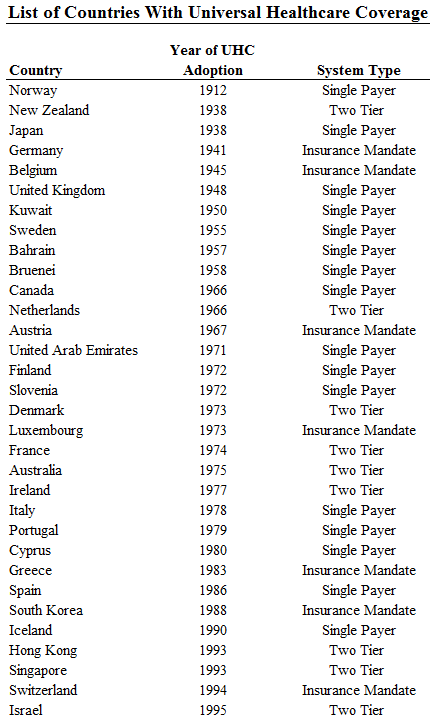
All about How Many Countries Have Universal Health Care
Lee (CA-13), Rep. Ocasio-Cortez (NY-14), Rep. Omar (MN-05), Rep. Pocan (WI-02), Rep. Pressley (MA-07) Rep. Raskin (MD-08), Rep. Schakowsky (IL-09), Rep. Adam Smith (WA-09), Rep. Watson Coleman (NJ-12) National Nurses United, Public Person, National Union of Health Care Employees, Social Security Functions, Labor Project for Single Payer, Center for Popular Democracy, One Payer States, Healthy California Now!, California Physicians for a National Health Program, National Economic and Social Rights Effort, Whole Washington, Healthcare for All Oregon, Oregon Physicians for a National Health Program ### Congressman Khanna represents the 17th District of California, which covers neighborhoods in Silicon Valley.
( Transcribed from a talk provided by Karen S. Palmer MPH, MS in San Francisco at the Spring, 1999 PNHP conference) The project for some form of universal government-funded health care has actually stretched for almost a century in the US On several celebrations, advocates thought they were on the brink of success; yet each time they dealt with defeat.
Other industrialized countries have had some kind of social insurance (that later developed into nationwide insurance coverage) for almost as long as the United States has been trying to get it. Some European countries started with obligatory sickness insurance, among the first systems, for workers beginning in Germany in 1883; other nations including Austria, Hungary, Norway, Britain, Russia, and the Netherlands followed all the method through 1912.
So for a long time, other countries have had some type of universal health care or at least the starts of it. The main reason for the introduction of these programs in Europe was earnings stabilization and defense versus the wage loss of illness rather than payment for medical expenditures, which came later on.
In a seeming paradox, the British and German systems were developed by the more conservative federal governments in power, specifically as a defense to counter expansion of the socialist and labor parties. They used insurance versus the cost of sickness as a way of "turning benevolence to power". What was the US doing during this duration of the late 1800's to 1912? The government took no actions to support voluntary funds or make sick insurance compulsory; basically the federal government left matters to the states and states left them to private and voluntary programs.
In the Progressive Age, which happened in the early 20th century, reformers were working to improve social conditions for the working class. However unlike European countries, there was not powerful working class assistance for broad social insurance in the United States The labor and socialist celebrations' support for medical insurance or illness funds and advantages programs was a lot more fragmented than in Europe.
Throughout the Progressive Age, President Theodore Roosevelt was in power and although he supported medical insurance due to the fact that he believed that no country might be strong whose people were ill and bad, the majority of the effort for reform happened outside of government. Roosevelt's followers were mainly conservative leaders, who postponed for about twenty years the sort of presidential management that may have involved the nationwide federal government more thoroughly in the management of social well-being. how does electronic health records improve patient care.
What Does What Is Single-payer Health Care Do?
They were a common progressive group whose required was not to eliminate capitalism however rather to reform it. In 1912, they created a committee on social welfare which held its first nationwide conference in 1913. Regardless of its broad required, the committee chose to focus on health insurance, preparing a model expense in 1915.
The services of doctors, nurses, and hospitals were included, as was sick pay, maternity advantages, and a survivor benefit of fifty dollars to spend for funeral service costs. This survivor benefit ends up being substantial in the future. Expenses were to be shared in between workers, companies, and the state. In 1914, reformers looked for to include physicians in formulating this expense and the American Medical Association (AMA) really supported the AALL proposition.